

Subscribe to Claus’ Substack with a 40% discount
An arm in every pie
Except the most delicious
Written by Claus Aasholm
Claus is an expert at peeling back the layers of polished corporate messaging.
His curiosity drives him to explore semiconductor companies, focusing on the complexities of their supply chains—both upstream and downstream.
He compares companies to their competitors, uncovering key insights that often go unnoticed.
From a quiet, predictable industry, the semiconductor market has turned into a quagmire of hourly news predicting either the arrival of the singularity or the end of the universe. The delivery vehicles are AI-generated catastrophising infographics on LinkedIn, sending AI stocks on a zigzag course. I don’t even want to think about what the dystopia formerly known as Twitter looks like these days.
Despite being under constant pressure — from geopolitics to policy — the industry remains resilient. Time after time, it adapts.
With the US excursing in the Gulf, helium supply is now at risk, echoing the neon shortages during the bombardment of Mariupol. Tariffs and embargoes have also had unintended consequences, effectively shielding domestic industries and allowing Chinese startups to build sustainable semiconductor and AI ecosystems without government aid.
You know I follow all the news, but I don’t react to every hourly “catastrophe”. My timing is based on data, not noise.
My mental model for announcements remains:
– Announcement ≠ Action
– Action ≠ Scale
– Scale ≠ Completion
– Completion ≠ Outcome
Announcements move markets, but rarely reflect reality in isolation.
A recent example is Google’s TurboQuant model, which reportedly reduces memory usage by 6x for LLM inference. The implication is clear: more efficient models, less memory demand. The market reacted immediately, sending memory stocks lower — just as it did with DeepSeek earlier this year.
But this reaction is based on assumption, not evidence. Lower cost models do not automatically mean lower memory demand.
Which brings me to ARM.
ARM began in 1990 as a quintessentially British success story — clever engineering, Cambridge roots, and a business built on intellectual property. Today, after its acquisition by SoftBank and a failed Nvidia takeover, it sits as one of the most critical players in the semiconductor ecosystem, with its IP in over 350 billion devices.
At the recent ARM Everywhere event, the company unveiled its first merchant processor — the ARM AGI CPU — marking a shift towards a more integrated, Nvidia-style model. This includes full server configurations, from air-cooled racks with thousands of cores to liquid-cooled systems with tens of thousands and petabytes of memory.
While CPU-based servers may sound like a step backwards in an AI world dominated by GPUs, ARM’s insight is clear: AI workloads are driving a surge in CPU demand.
Rene Haas expects data centre CPU usage to increase from 30 million to 120 million cores per gigawatt — a 4x increase. AI workloads may be driven by accelerators, but CPUs handle orchestration. As GPU-to-CPU ratios shift, cheaper CPUs could replace expensive GPUs, each requiring their own memory allocation.
That has implications for memory demand — potentially the opposite of what the market assumed after TurboQuant.
ARM’s business model reflects this shift. Its two revenue streams — licenses and royalties — operate as a two-stage engine: licenses drive future royalties, typically over a 2–3 year cycle.
Recent changes, such as the move to subscription-based “Total Access” models and the introduction of Compute Subsystems (CSS), have increased both customer stickiness and royalty value. ARM is no longer selling interchangeable IP blocks; it is delivering integrated platforms that accelerate time-to-market and deepen dependency.
The next step — silicon as a service — pushes ARM closer to competing with its own customers. Risky, but calculated.
ARM’s position in the ecosystem gives it leverage. From Apple to hyperscalers, its IP is foundational. Over time, it has shifted from a transactional model to one that actively shapes the customer journey — increasing both lock-in and long-term value.
At the same time, ARM is targeting one of the last strongholds: x86.
While Intel and AMD still dominate, particularly in servers, the shift towards power efficiency and AI workloads is creating an opening. ARM’s share is growing, and its strategy is clearly aimed at attacking that position.
As always, I’ll return to the model:
Announcements are not outcomes.
But if the direction is right, the outcomes tend to follow.
Strategic Stewardship for a New Era of Semiconductor Leadership
The global semiconductor industry has crossed a threshold. The disruptions of 2025–2026—memory shortages, governance failures, geopolitical trade interventions, and now the outbreak of the Iran War—are no longer isolated shocks. They are the emerging normal.
Semiconductor firms now operate in a landscape defined by persistent crisis, fragmentation, and the growing securitization of technology. The question is no longer how to navigate disruption, but how to operate within it.
Background: Memory, Governance and Geopolitics
The memory market entered 2026 under significant strain. AI data-centre demand absorbed unprecedented DRAM capacity, pushing prices sharply higher. Contract prices rose 55–60% in Q1 2026, with PC DRAM increasing over 100% in a single quarter. Downstream industries were forced into defensive allocation strategies, exposing how quickly a single demand driver can distort global supply.
At the same time, the Dutch government’s emergency intervention in Nexperia triggered wider consequences. Export restrictions, automotive production risks, and supply chain disruption followed, highlighting a new reality: even mature-node components are now critical infrastructure.
The outbreak of the Iran War adds another layer. While not directly a semiconductor event, its implications are clear: energy volatility, shipping disruption, increased cyber risk, and further securitization of technology. Geopolitical “wildcards” can now reshape the industry overnight.
A Market Defined by Structural Forces
These events reveal a deeper shift. Semiconductor markets are no longer purely cyclical, but shaped by four structural dynamics:
1. The Securitization of Technology
Headquarters location is now a geopolitical decision. Semiconductor firms are increasingly treated as national assets, aligned with the strategic interests of their home markets.
2. Fragmenting Sovereignties
Export controls, localization policies, and trade restrictions are now core operating conditions. Companies spanning jurisdictions face increasing instability as regulatory systems diverge.
3. Capacity Capture by AI
AI is no longer a temporary demand spike. It is setting the template for future compute-intensive industries, from autonomy to defense, each capable of distorting supply in similar ways.
4. Geopolitical Unpredictability
Events like the Iran War reinforce a baseline assumption: volatility is constant.
Together, these forces suggest a shift from efficiency-driven models to resilience-led strategies.
Toward a New Semiconductor Strategy
Governance must evolve.
Semiconductor firms now resemble strategic infrastructure. Governance failures can trigger political intervention, as seen with Nexperia. Oversight must match this level of importance.
Strategic foresight must become operational.
Companies must plan for geopolitical scenarios, not just market conditions. This includes diversifying assets across aligned regions, building redundancy into supply chains, and integrating geopolitical expertise at board level.
Portfolio resilience is critical.
Systemic risk often sits in mature components. Power discretes, analog, and memory remain points of fragility. Multi-region production, second sourcing, and modular design are essential.
Engagement must expand.
Operating across trade zones now requires active alignment with governments and regulatory bodies. Trust, transparency, and diplomacy are becoming core capabilities.
Conclusion
The semiconductor industry is no longer defined by cycles, but by structural instability. Memory shocks, governance crises, and geopolitical conflict all point to the same reality: semiconductors are now geopolitical assets.
Strategy must adapt accordingly. Governance must reach national-security standards. Foresight must anticipate political dynamics. And even the choice of headquarters now carries strategic consequence. The companies that succeed will not be those that avoid complexity, but those that are built to operate within it.
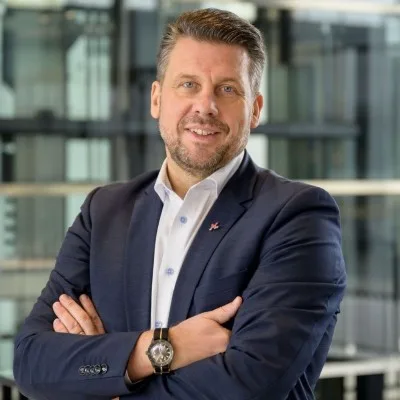
Written by Ole Gerkensmeyer
Chief Strategy Officer | Nexperia

We’re Already In It: The 20-Year Semiconductor Super Cycle
Written by Shawn Mahon
Semiconductors. Supply Chain. Blockchain
At CES this year, an OEM customer asked me a familiar question: “Just warn me when the next cycle is coming so we can get ahead of allocation.” My response surprised them: we’re already in it. You’re standing at the beginning of a 20-year super cycle.
The tell? Memory markets are sold out for the next two years. Not tight — sold out. HBM capacity is allocated through 2026. DRAM pricing has inflected. This isn’t the typical 3–4 year inventory cycle. This is something different.
The Convergence Nobody Planned For
We’re seeing a rare alignment of demand drivers that compound rather than substitute.
AI and data centres aren’t just consuming chips — they’re consuming everything: power, cooling, networking, storage. Capex is already locked in for the decade. Energy infrastructure is undergoing a generational rebuild. Grid upgrades, battery storage, EV charging and AI data centres are all competing for the same semiconductors. This demand is policy-driven and price-inelastic.
At the same time, a generational refresh cycle is just beginning. AI-capable devices — from Copilot+ PCs to Apple Silicon — are replacing legacy hardware. Even local AI use cases are driving demand. People are buying hardware to run AI at home. Local inference is becoming a category.
Robotics and autonomy have crossed the threshold from concept to ROI. From robotaxis to humanoids in warehouses, each deployment multiplies semiconductor content per unit of output. And defense has entered a semiconductor arms race. Modern warfare is semiconductor warfare. These aren’t separate cycles — they reinforce each other.
Why This Cycle Is Different
The macro backdrop matters.
We’re moving into what Cem Karsan describes as a “wartime economy”: strategic competition, protectionism and higher inflation. The old model of lowest cost and just-in-time supply chains is breaking. The CHIPS Act, Europe’s response, and China’s self-sufficiency push represent hundreds of billions in committed capital. Efficiency is being sacrificed for resilience. That’s structural.
The Software-to-Physical Rotation
For a decade, capital favoured software. That’s now reversing.
As AI moves into the physical world, hardware, infrastructure and commodities become critical. The world is not prepared for the electricity, hardware and materials required.
Software scales. Atoms don’t. Capital is rotating back into fabs, power, and supply chains. Semiconductors sit at the centre of that shift.
The Taiwan Variable — and the Myth of “Safe” Nodes
TSMC’s dominance introduces a structural risk. But the bigger issue is how risk is distributed across node types.
– Advanced nodes (<7nm): constrained by physics and capital
– Mid-range nodes: constrained by reshoring timelines
– Mature nodes: constrained by geopolitical exposure
The idea that mature nodes are “safe” is wrong. Over decades, cost optimisation concentrated 70–80% of assembly capacity for basic components in China. These aren’t advanced chips — but when export controls or policy shifts hit, they become immediate bottlenecks.
We saw it during the pandemic: billion-dollar production losses caused by the absence of low-cost components. The industry learned the lesson — briefly — and then reverted to cost optimisation. The difference now is that disruptions are policy-driven, not accidental.
What a 20-Year Cycle Means
A super cycle doesn’t remove volatility. It changes its direction. Instead of mean reversion, volatility happens around a rising trend. Demand is structural. Supply is constrained. Capital intensity is increasing. Policy support is locked in. The key difference from previous cycles: the demand floor keeps rising.
Every AI device, every automated factory, every modernised grid adds to a permanent install base that requires ongoing semiconductor production.
The Practical Implications
If this is right, allocation becomes strategic.
– Allocation determines your ability to ship
– Planning cycles must extend beyond quarters
– Supplier relationships compound in value
– Node-level risk must be understood
– Working capital requirements increase
This isn’t temporary. If the 20-year thesis holds, this isn’t a cycle to manage — it’s a new operating environment.

Written by:
James Cunningham – Business Development Director
As well as writing long-term success stories, our aim is to contribute to the health of the industry as a whole.
IC Resources has been supporting the deep-tech community since 1999. We are an independent, founder-led recruitment consultancy with a team of 70 specialist consultants who operate across Semiconductor, Electronics, Software, AI, Photonics and Quantum.
Q1 2026 Highlights
From our observations as search experts in deep tech there is a pattern emerging… semiconductor, photonics, and quantum technology sectors are converging:
In Semiconductors, the push beyond traditional scaling has intensified focus on advanced packaging, integration, and domain-specific architectures for AI. Companies like NVIDIA and TSMC are driving innovation not just through smaller nodes, but through system-level performance gains, particularly for data centres and edge AI. A consistent pattern is the need for packaging experts that can unlock the full capabilities of new technologies.
Photonics is still a growth space with silicon photonics highlighting the limits of electronic interconnects. Firms such as Intel and Cisco are investing in optical I/O and co-packaged optics to improve bandwidth and energy efficiency for hyperscale applications. Interesting also is to see the technology being applied into sensing, LiDAR, and medical imaging rather than all chasing the same design slots.
Quantum technologies are transitioning from theoretical exploration to early commercialization. Companies like IBM and Rigetti Computing are developing quantum processors, while startups focus on error correction, control systems, and quantum networking. Governments globally continue to fund national quantum initiatives, reinforcing the strategic importance of the field. Making the systems robust and scalable is proving to be a challenge for some.
Across all three domains, there is a noticeable shift towards interdisciplinary skill sets: combining materials science, software, and systems engineering. We see demand for engineers who can operate across these boundaries, particularly in AI-driven design, photonic integration, and quantum algorithm development.
In general, the broader trend is less about headcount growth and more about technical specialisations aligned with emerging architectures and applications. It’s an interesting world out there!
For more information on any of the articles featured in this edition of The IC Resource, or if you would like to contribute to our future editions, please get in touch – james.cunningham@ic-resources.com or +44 (0)118 988 1166.6.
1530 Arlington Business
Park, Berkshire.
RG7 4SA
© Intellectual Capital Resources Ltd 2024
